RRSP limit 2027 — $35,390, and the 2026 salary it takes to earn it
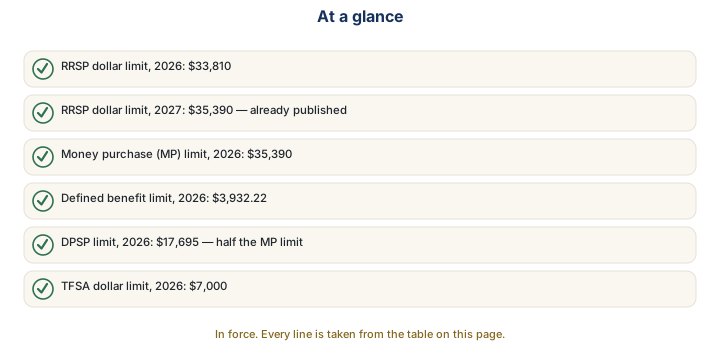
Quick answer: The RRSP limit for 2027 is $35,390, up from $33,810 for 2026. Your own 2027 room is 18% of your 2026 earned income up to that cap, so reaching the maximum takes about $196,612 of salary in 2026 — and for an incorporated owner, dividends create no RRSP room at all.
On this page
- The RRSP limit for 2027 and 2026
- Why the 2027 figure is already known
- How your own 2027 RRSP room is worked out
- The 2026 earned income it takes to reach the 2027 maximum
- Who this matters to
- What to do before the end of 2026
- The terms used on this page
- Common questions about the RRSP limit 2027
- Where this comes from
The RRSP limit for 2027 and 2026
| Figure | Amount |
|---|---|
| RRSP dollar limit, 2027 | $35,390 — already published |
| RRSP dollar limit, 2026 | $33,810 |
| Money purchase (MP) limit, 2026 | $35,390 |
| Increase in the RRSP dollar limit, 2026 to 2027 | $1,580 |
| Money purchase (MP) limit, 2027 | Not yet published by the CRA |
The RRSP contribution limit for 2027 is $35,390. That is the ceiling on new room anyone can earn for 2027, whatever their income. The 2026 figure, for comparison, is $33,810.
The CRA has not published the 2027 money purchase limit, which sets the 2028 RRSP limit; it usually appears in November. The 2026 MP limit of $35,390 is the latest and fixes the 2027 RRSP limit.
Why the 2027 figure is already known
Most annual tax figures are announced late in the year before they apply. The 2027 RRSP limit is different, and the reason is structural rather than a matter of timing.
Each year’s RRSP dollar limit equals the previous year’s money purchase limit, the cap on defined contribution pension contributions. So the 2027 limit is $35,390.
The same thing happened a year earlier. The 2026 RRSP limit of $33,810 is the 2025 money purchase limit. Because the RRSP figure runs a year behind by design, you can plan next year’s RRSP around a number that is already known.
How your own 2027 RRSP room is worked out
RRSP room is not a flat allowance. For any year it is 18% of the previous year’s earned income, capped at that year’s RRSP dollar limit, then adjusted for any pension adjustment and carried-forward room.
Applied to 2027, that means:
- Take 18% of your 2026 earned income.
- Cap the result at the 2027 RRSP dollar limit of $35,390.
- Adjust for any pension adjustment if you belong to a registered pension plan.
- Add any unused room carried forward from earlier years.
The phrase doing the work is earned income. Salary and wages count. Net rental income and some other sources count. Dividends do not. Neither do capital gains.
Your own limit is on your notice of assessment. The $35,390 figure is the cap that applies to everyone; your notice shows where you personally stand against it once your 2026 return has been assessed.
The 2026 earned income it takes to reach the 2027 maximum
Because 2027 room is built from 2026 income, the year that decides your 2027 RRSP is the one now ending.
| Step | Detail |
|---|---|
| The 2027 RRSP dollar limit | $35,390 |
| Room accrues at | 18% of the previous year’s earned income |
| So the 2026 earned income needed | $35,390 ÷ 18% = $196,611.11, rounded up to $196,612 |
| Earned income of $100,000 instead | $18,000 of room |
| Paid entirely in dividends | $0 of room |
About $196,612 of 2026 earned income fully funds the 2027 limit, versus about $187,833 of 2025 income for 2026. Below that, room is 18% of earnings, using only CRA figures.
Who this matters to
Anyone with RRSP room can use the figure, but the decision only becomes live for owner-managers, who choose how they are paid.
Dividends-only in 2026 adds no 2027 room. Salary adds 18% of salary up to $35,390. A very profitable corporation paying only dividends creates zero room.
It is one input: salary brings CPP on both sides, so RRSP room argues for considering salary, not choosing it outright. Our guide to RRSPs and dividends for business owners and the salary vs dividends calculator run the numbers.
Pension plan members get less than 18% because of the pension adjustment. Past under-contributors may have more than $35,390 for 2027 through carry-forward.
What to do before the end of 2026
Decide it at compensation time. RRSP room for 2027 is fixed by what you earn in 2026 — nothing done at the contribution deadline changes the limit itself.
If you are paid in dividends and want 2027 RRSP room, that is a reason to revisit the salary-versus-dividend split before the 2026 year end, not after. Our salary vs dividends guide for 2026 sets out the other factors that belong in that decision.
Unused room carries forward indefinitely, so a low-salary year is not lost. It is deferred.
The practical point. Set 2026 pay with 2027 RRSP room in mind; the RRSP deadline is too late. Dividends create no room, however profitable the year.
For this year’s figure and the 2025 income it was built from, see the 2026 RRSP dollar limit. Using your limit well is part of personal tax planning each spring.
The terms used on this page
- RRSP dollar limit
- The maximum RRSP room that can accrue for a year, whatever the income. Set to the previous year’s money purchase limit, which is why the 2027 figure is already known.
- Earned income
- The income RRSP room is calculated from — salary and wages count, dividends and capital gains do not.
- Money purchase (MP) limit
- The annual cap on contributions to a defined contribution pension plan. The RRSP dollar limit follows it a year later.
- Pension adjustment
- A reduction to RRSP room reflecting benefits already earned in a registered pension plan.
- Carry-forward room
- Unused RRSP room from earlier years, which accumulates indefinitely.
Common questions about the RRSP limit 2027
What is the RRSP limit for 2027?+
Is the RRSP contribution limit for 2027 the same as my limit?+
Why is the 2027 RRSP limit already published?+
How much do I need to earn in 2026 to max out my 2027 RRSP?+
Do dividends create RRSP room for 2027?+
How much higher is the 2027 limit than 2026?+
What happens to room I do not use?+
Where this comes from
Every figure on this page is taken from the source below, or calculated from it as shown:
General information, not tax advice. This page explains a published figure in general terms. It cannot account for your circumstances and does not create a professional relationship. Confirm anything that affects a decision — send an enquiry.
Have a question about this?
Ask free through the quick-question form; a CPA replies by email within one business day. A 45-minute Advice Call with a CPA is $225 plus GST, paid by secure link and credited to your first invoice if you become a client within 60 days. Want us to take it on? Send an enquiry.
The limit is only useful next to the rest of the picture, which is personal tax planning for the year.
“…We switched to him last year for both our personal and small-business taxes — responsive, knowledgeable and quick.”