The 2026 TFSA contribution limit is $7,000
Quick answer: The TFSA dollar limit for 2026 is $7,000. Unused room from earlier years continues to carry forward, and amounts withdrawn are added back to room at the start of the following calendar year.
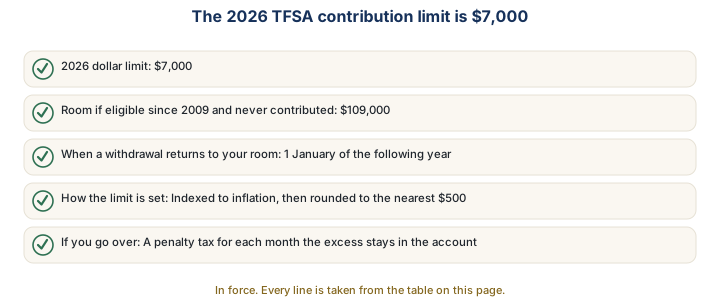
The 2026 TFSA numbers, in one place
| Figure | 2026 |
|---|---|
| 2026 dollar limit | $7,000 |
| Room if eligible since 2009 and never contributed | $109,000 |
| When a withdrawal returns to your room | 1 January of the following year |
| How the limit is set | Indexed to inflation, then rounded to the nearest $500 |
| If you go over | A penalty tax for each month the excess stays in the account |
The carry-forward is why the annual figure alone rarely answers the question — the number that matters is your own room, not the year’s limit.
How it works
A Tax-Free Savings Account is not a type of investment. It is a wrapper you put investments inside. Cash, GICs, mutual funds, ETFs and stocks can all sit in a TFSA, and what the account does is change how they are taxed rather than what they earn.
Inside a TFSA, growth is not taxed. Interest, dividends and capital gains all accumulate free of tax, and — the part that separates a TFSA from an RRSP — money taken out is not taxed either. You get no deduction for putting money in, and you pay no tax taking it out.
What limits you is contribution room. Each year the government sets a dollar limit, and your room is the total of every year's limit since you turned 18 or since 2009, whichever came later, minus what you have already put in, plus anything you have taken out in past years. Room is per person and never expires.
The 2026 limit is $7,000. The limit is indexed to inflation and then rounded to the nearest $500, which is why it holds at the same figure for several years and then steps up rather than drifting a little each year.
How it applies to you
Every Canadian resident aged 18 or older has TFSA room, whether or not they have ever opened an account. Room accrues automatically. If you have been eligible since 2009 and have never contributed a dollar, you have $109,000 of room available in 2026.
You do not need income to get room, which is the practical difference from an RRSP. A student with no earnings still accumulates TFSA room every year; they accumulate no RRSP room at all.
Room follows the person, not the account. Having three TFSAs at three institutions does not give you three limits — it gives you one limit spread across three accounts, and it makes it considerably easier to lose track of the total.
How to calculate it
Contribution room is a running balance. Work it in this order, because the order is where people go wrong:
| Step | Detail |
|---|---|
| Start with your unused room carried forward | from your CRA account, or the sum of every limit since you became eligible |
| Add this year’s limit | $7,000 for 2026 |
| Add any withdrawals you made in a PREVIOUS year | these return to your room on 1 January |
| Subtract contributions you have already made this year | |
| The result is what you can still put in | without penalty |
A worked example. Someone eligible since 2009 who has never contributed has $109,000 of room in 2026. If they contribute $50,000 in March 2026, their remaining room is $109,000 − $50,000 = $59,000. If they then withdraw $10,000 in July 2026, that $10,000 does not return to their room until 1 January 2027 — their room for the rest of 2026 stays at $59,000.
What changed
The annual limit is indexed and rounded to the nearest $500, so it holds steady across some years rather than moving every year. Someone eligible since 2009 who has never contributed has $109,000 of room in 2026.
What to do
The single most common TFSA mistake is re-contributing a withdrawal in the same calendar year. Someone takes $10,000 out in July, puts it back in November, and treats the account as though nothing happened. The CRA treats the November deposit as a fresh contribution against room that is already used, and charges a penalty on the excess for every month it remains.
The rule to remember is simple: money you withdraw comes back to your room on 1 January of the following year, not immediately.
If you are unsure of your room, your CRA My Account shows it — but it is only updated once your financial institutions have reported, so it can lag a contribution you made recently. When the figure matters, count it yourself from your own records.
The practical point. The single most common TFSA error is re-contributing a withdrawal in the same calendar year, which creates an over-contribution penalty. Room from a withdrawal returns on 1 January, not immediately.
The terms used on this page
- Contribution room
- The total you are allowed to have put into a TFSA, cumulative since you became eligible.
- Over-contribution
- Any amount above your room. It attracts a penalty tax for each month it stays in the account.
- Indexed
- Adjusted each year in line with inflation. The TFSA limit is then rounded to the nearest $500.
Common questions about the 2026 TFSA contribution limit is $7,000
How much can I put in for 2026?+
Can I put back money I withdrew this year?+
What happens if I over-contribute?+
Why did the limit not change from last year?+
Where this comes from
Every figure on this page is taken from the source below, not from interpretation:
General information, not tax advice. This page explains a change in general terms. It cannot account for your circumstances and does not create a professional relationship. Confirm anything that affects a decision — book a free consult.
Have a question about this?
A one-off Advice Call is a paid 45-minute session with a Chartered Professional Accountant — $200 plus GST, booked by email or phone with a secure payment link, credited against your first invoice if you become a client within 60 days. Looking for an accountant to take this on rather than an answer? The first consultation is free.
“Highly recommend working with Sunny. We switched to him last year for both our personal and small-business taxes — responsive, knowledgeable and quick.”