TFSA limit 2027: not yet published, and how your 2027 room adds up
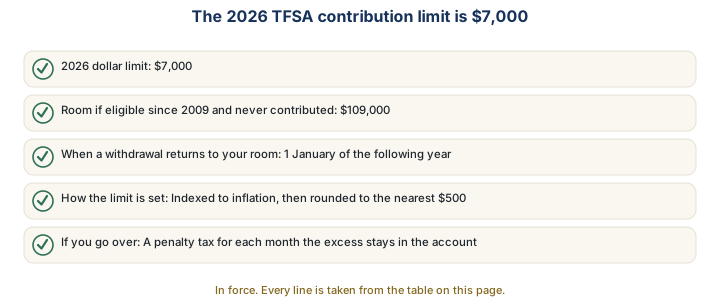
Quick answer: The TFSA contribution limit for 2027 has not been published yet. The CRA normally announces the next year’s TFSA dollar limit in November, and this page will show the 2027 figure as soon as it is published. For reference, the 2026 limit is $7,000. Unused room carries forward, and anything you withdraw in 2026 is added back to your room on 1 January 2027.
The 2027 TFSA numbers, in one place
| Figure | 2027 | 2026 (for reference) |
|---|---|---|
| Dollar limit | Not yet published — normally announced in November | $7,000 |
| Room if eligible since 2009 and never contributed | $109,000 plus the 2027 limit, once announced | $109,000 |
| When a withdrawal returns to your room | 2027 withdrawals return on 1 January 2028 | 2026 withdrawals return on 1 January 2027 |
| How the limit is set | Indexed to inflation, then rounded to the nearest $500 | Indexed to inflation, then rounded to the nearest $500 |
| If you go over | A penalty tax for each month the excess stays in the account | A penalty tax for each month the excess stays in the account |
Only one number in that table is missing, and it is the one most people search for. Everything else about 2027 — how room carries forward, when withdrawals come back, what an over-contribution costs — works exactly as it does in 2026, and you can plan around it now. The full 2026 picture is on our 2026 TFSA limit page.
When the 2027 TFSA limit is announced
The CRA normally announces the next year’s TFSA dollar limit in November, once the year’s inflation figure is final. As of 24 October 2026 the 2027 figure has not been published.
When it is announced, we will add it here and update the table and room calculation. Until then, treat any “2027 TFSA limit” quoted elsewhere as an estimate, not the CRA’s number. We will not guess, because contributing on a guessed figure is how over-contributions start.
How the TFSA limit is set each year
The limit is indexed to inflation and rounded to the nearest $500, so it holds at one figure for several years and then steps up rather than drifting each year.
That rounding is the reason an announcement is worth waiting for. A small change in the inflation figure can change where the rounded limit lands, so the only reliable answer is the published one. The 2026 limit, for reference, is $7,000. Other amounts that move with inflation, such as the tax brackets, are covered on our 2026 indexation page.
How a TFSA works
Growth inside a TFSA is not taxed: interest, dividends and capital gains accumulate tax-free, and, unlike an RRSP, withdrawals are tax-free too. There is no deduction going in and no tax coming out. The RRSP side, including its 2027 figure, is on our RRSP dollar limit page.
Contribution room is the limit. Your room is every year’s dollar limit since you turned 18 or since 2009, whichever is later, minus contributions, plus past years’ withdrawals. Room is per person and never expires.
Your 2027 TFSA room
Every Canadian resident aged 18 or older has TFSA room, whether or not they have ever opened an account. Room accrues automatically. If you have been eligible since 2009 and have never contributed a dollar, you have $109,000 of room available in 2026.
On 1 January 2027 the 2027 dollar limit is added on top. For that same person, 2027 room will be $109,000 plus the 2027 limit, once the CRA announces it. If you contributed in earlier years, your starting point is lower; if you withdrew in 2026, it is higher, because those withdrawals come back on 1 January 2027.
Room follows the person, not the account. Having three TFSAs at three institutions does not give you three limits — it gives you one limit spread across three accounts, and it makes it considerably easier to lose track of the total.
How to calculate your 2027 room
Contribution room is a running balance. Work it in this order, because the order is where people go wrong:
| Step | Detail |
|---|---|
| Start with your unused room at the end of 2026 | from your CRA account, or the sum of every limit since you became eligible, less what you have put in |
| Add the 2027 limit | not yet published; the CRA normally announces it in November |
| Add any withdrawals you made in 2026 | these return to your room on 1 January 2027 |
| Subtract contributions you have already made in 2027 | |
| The result is what you can still put in | without penalty |
A worked example. Someone eligible since 2009 who has never contributed has $109,000 of room in 2026. If they contribute $50,000 in March 2026, their remaining room is $109,000 − $50,000 = $59,000. If they then withdraw $10,000 in July 2026, that $10,000 does not return to their room until 1 January 2027 — their room for the rest of 2026 stays at $59,000.
On 1 January 2027 their room becomes $59,000 + $10,000 = $69,000, plus the 2027 limit once the CRA announces it.
What to do before 1 January 2027
The single most common TFSA mistake is re-contributing a withdrawal in the same calendar year. Someone takes $10,000 out in July, puts it back in November, and treats the account as though nothing happened. The CRA treats the November deposit as a fresh contribution against room that is already used, and charges a penalty on the excess for every month it remains.
The rule to remember is simple: money you withdraw comes back to your room on 1 January of the following year, not immediately. If you took money out in 2026 and want to put it back, wait until 1 January 2027.
Withdrawal timing works in reverse. A December 2026 withdrawal is added back on 1 January 2027; a January 2027 one waits until 1 January 2028. If you were withdrawing around the turn of the year anyway, the date matters.
Your CRA My Account shows your room, but only after financial institutions report, so it can lag a recent contribution. When it matters, count from your own records, and add the 2027 limit only once published.
The practical point. The 2027 TFSA limit is not out yet, and you cannot use it before 1 January 2027 in any case. Until then, work from your 2026 room, and do not put back a 2026 withdrawal before 1 January 2027.
Choosing between the TFSA and the RRSP for a given year depends on your bracket now and later; a CPA-prepared personal return is a good moment to settle it.
The terms used on this page
- Contribution room
- The total you are allowed to have put into a TFSA, cumulative since you became eligible.
- Dollar limit
- The amount added to every eligible person’s TFSA room on 1 January each year. The 2027 figure has not been published yet.
- Over-contribution
- Any amount above your room. It attracts a penalty tax for each month it stays in the account.
- Indexed
- Adjusted each year in line with inflation. The TFSA limit is then rounded to the nearest $500.
Common questions about the TFSA limit 2027
What is the TFSA limit for 2027?+
When will the CRA announce the 2027 TFSA contribution limit?+
How much 2027 TFSA room will I have if I have never contributed?+
I withdrew money from my TFSA in 2026. When can I put it back?+
Can I use my 2027 room before 1 January 2027?+
Where this comes from
Every figure on this page is taken from the source below, not from interpretation. The 2027 dollar limit will be added from the same source once it is published:
General information, not tax advice. This page explains a change in general terms. It cannot account for your circumstances and does not create a professional relationship. Confirm anything that affects a decision — send an enquiry.
Have a question about this?
Ask free through the quick-question form; a CPA replies by email within one business day. Need a proper look? A 45-minute Advice Call is $225 plus GST, paid by secure link and credited to your first invoice if you become a client within 60 days. Want an accountant to take it on? Send an enquiry.
“…We switched to him last year for both our personal and small-business taxes — responsive, knowledgeable and quick.”