Tax bracket indexation for 2026 — Brackets and credits were indexed by 2.0% federally, 2.2% in BC
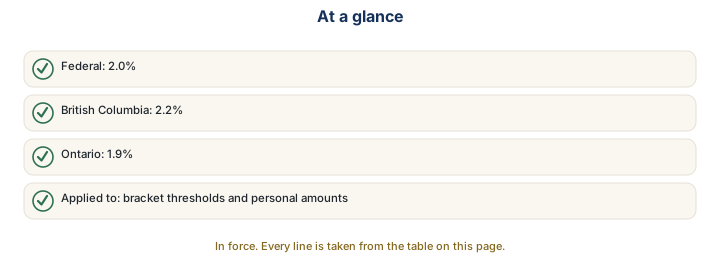
Quick answer: The federal indexing factor for 1 January 2026 is 2.0%. Provincial factors differ: British Columbia is 2.2% and Ontario is 1.9%.
How it works
Tax brackets and many credits are stated as dollar amounts. If those amounts never moved, inflation alone would push people into higher brackets and quietly erode the value of every credit — an effect called bracket creep.
Indexation prevents that. Each year the thresholds and personal amounts are adjusted by an indexing factor, so the same real income faces roughly the same tax.
The federal indexing factor for 1 January 2026 is 2.0%. Provincial factors are set separately and differ: British Columbia is 2.2% and Ontario is 1.9%.
The adjustment happens automatically in payroll withholding. An employee does not need to file a new TD1 for it to take effect.
Indexation is neither a tax cut nor a tax rise. It aims to leave you where you were: if income rose by exactly the indexing factor, real tax is broadly unchanged. It prevents a silent increase nobody voted for.
Federal and provincial indexation are set independently, which is why the factors differ. Each government adjusts its own brackets and its own credits, so the combined rate on a given income moves by an amount that is neither the federal figure nor the provincial one.
How it applies to you
Everyone who pays personal tax, though most people never notice it — the thresholds simply move and take-home pay adjusts.
It matters most in two situations: where income sits close to a bracket boundary, and where a credit is being claimed near a phase-out threshold. In both, a small movement in the threshold changes the outcome.
For anyone doing their own planning, the important detail is that federal and provincial factors differ. A single combined assumption applied to both will drift apart from reality over a year.
How to calculate it
The 2026 factors:
| Step | Detail |
|---|---|
| Federal | 2.0% |
| British Columbia | 2.2% |
| Ontario | 1.9% |
| Applied to | bracket thresholds and personal amounts |
Federal and BC factors differ, so thresholds move by different amounts at each level. Prior-year thresholds carried forward will be wrong at both, by different amounts — harder to spot than one error.
What changed
Indexation moves the bracket thresholds and the personal amounts. It is applied automatically in payroll withholding, whether or not an employee files a new TD1.
What to do
If you maintain a planning spreadsheet or calculate your own instalments, refresh the thresholds. Carrying last year’s numbers forward is the most common source of a wrong estimate.
You do not need to do anything for payroll — indexation is applied automatically in the withholding tables.
Where income sits near a bracket boundary, the movement is worth checking rather than assuming. It can change what a bonus or a dividend costs.
The practical point. Because federal and provincial factors differ, a combined rate assumption carried over from last year will drift. Any planning spreadsheet built on prior-year thresholds should be refreshed.
Indexation moves the brackets and credits on every return for the year; personal tax filing applies the new figures automatically.
The terms used on this page
- Indexation
- The annual adjustment of tax thresholds and credits in line with inflation.
- Bracket creep
- Being pushed into a higher bracket by inflation alone, without any real increase in income.
- TD1
- The form declaring your credits to an employer. Indexation applies without filing a new one.
- Phase-out threshold
- The income level at which a credit begins to reduce.
Common questions about tax bracket indexation for 2026
What was indexed, and by how much?+
Do I have to do anything to get it?+
Why does it matter that the two factors differ?+
What should I check?+
Where this comes from
Every figure on this page is taken from the source below, not from interpretation:
General information, not tax advice. This page explains a change in general terms. It cannot account for your circumstances and does not create a professional relationship. Confirm anything that affects a decision — send an enquiry.
Have a question about this?
Ask free through the quick-question form; a CPA replies within one business day. Need more? A 45-minute Advice Call is $225 plus GST, credited to your first invoice if you become a client within 60 days. Want us to take it on? Send an enquiry.
“…have been completing my bookkeeping, taxes and financials for the last 2 years and they have been amazing. Thank you!”