Canada Carbon Rebate is not taxable — The Canada Carbon Rebate for Small Businesses is not taxable
Quick answer: Legislation passed on 26 March 2026 makes the Canada Carbon Rebate for Small Businesses non-taxable for all fuel charge years.
How it works
The Canada Carbon Rebate for Small Businesses returned a portion of federal fuel charge proceeds to Canadian-controlled private corporations.
When the rebates were paid, whether they counted as taxable income was unclear. Some corporations included them in income and paid tax on them; others did not.
Legislation passed on 26 March 2026 settles it: the rebate is not taxable. That applies to all fuel charge years, not only to years after the legislation.
The federal fuel charge is a levy applied to fuels in provinces covered by the federal system. It is paid at the point of supply, so a business bears it inside the price of fuel, heating and freight rather than as a separate tax bill.
The rebate returned a portion of those proceeds to small businesses. It arrived without an application in most cases, which is part of why its tax treatment went unexamined: money appeared, and whether it was income was decided differently by different preparers.
How it applies to you
Canadian-controlled private corporations that received the rebate.
The point that matters is the reach. Because the treatment applies to every fuel charge year rather than prospectively, a corporation that already reported a rebate as taxable income has paid tax on an amount now confirmed to be non-taxable.
Whether that is worth acting on depends on the amount. The rebate was calculated by reference to the number of people a business employed in a covered province, so a company with a handful of staff received a modest sum and a larger employer received more. The tax paid on it, at corporate rates, is a fraction of that again.
It is still worth checking. The work is small — look at how one line was treated on one return — and the answer is either "correct, nothing to do" or "tax paid on money that was never taxable".
How to calculate it
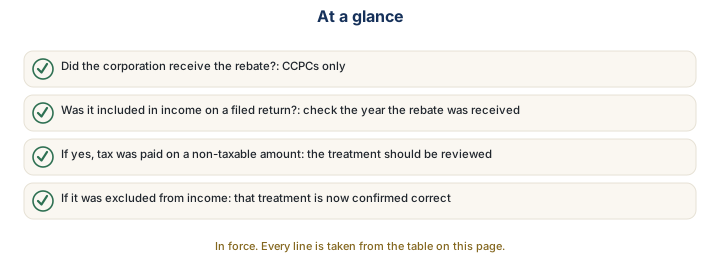
What to check on returns already filed:
| Step | Detail |
|---|---|
| Did the corporation receive the rebate? | CCPCs only |
| Was it included in income on a filed return? | check the year the rebate was received |
| If yes, tax was paid on a non-taxable amount | the treatment should be reviewed |
| If it was excluded from income | that treatment is now confirmed correct |
This is one of the few changes here that looks backwards. Most tax changes apply from a date forward; this one settles the treatment for every fuel charge year, which is why a filed return is worth revisiting rather than left alone.
What changed
The treatment of these amounts had been unclear, and some were included in income. The legislation settles it for every fuel charge year, not just going forward.
What to do
If your corporation received the rebate, check how it was reported. The amounts are not usually large, but tax paid on a non-taxable receipt is money that should not have left the company.
Where a return included it in income, the treatment should be reviewed with your accountant rather than adjusted informally.
Going forward the position is simply settled: the rebate is not income, and no entry is needed.
The practical point. If a rebate was reported as taxable income on a filed return, the treatment should be reviewed, since the change reaches back across fuel charge years rather than applying only prospectively.
The terms used on this page
- Fuel charge year
- The period the federal fuel charge is calculated over. The non-taxable treatment applies to all of them.
- Non-taxable receipt
- Money received that does not go into taxable income.
Common questions about canada Carbon Rebate is not taxable
Is the rebate taxable?+
Does this apply to rebates I already received?+
I reported a rebate as income. Can that be corrected?+
Why was there any confusion in the first place?+
Where this comes from
Every figure on this page is taken from the source below, not from interpretation:
General information, not tax advice. This page explains a change in general terms. It cannot account for your circumstances and does not create a professional relationship. Confirm anything that affects a decision — book a free consult.
Have a question about this?
A one-off Advice Call is a paid 45-minute session with a Chartered Professional Accountant — $200 plus GST, booked by email or phone with a secure payment link, credited against your first invoice if you become a client within 60 days. Looking for an accountant to take this on rather than an answer? The first consultation is free.
“Personal. Professional. Responsive. Plus he saved me a bundle!”