Lifetime capital gains exemption — The lifetime capital gains exemption stays at $1.25 million
Quick answer: The increase in the lifetime capital gains exemption to $1.25 million on qualified small business corporation shares and qualified farm or fishing property was kept, even though the inclusion rate increase announced alongside it was cancelled.
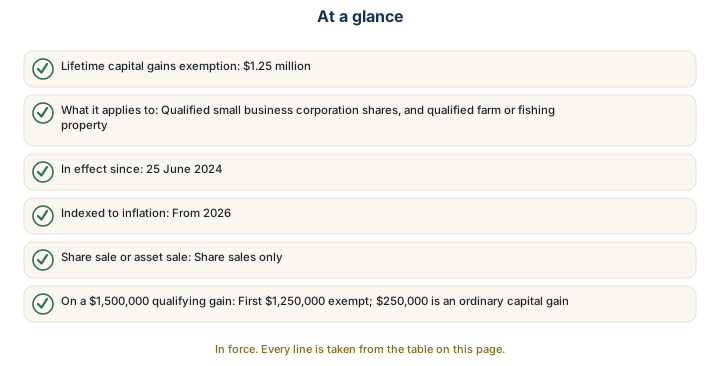
The exemption at a glance
| Figure | Current |
|---|---|
| Lifetime capital gains exemption | $1.25 million |
| What it applies to | Qualified small business corporation shares, and qualified farm or fishing property |
| In effect since | 25 June 2024 |
| Indexed to inflation | From 2026 |
| Share sale or asset sale | Share sales only |
| On a $1,500,000 qualifying gain | First $1,250,000 exempt; $250,000 is an ordinary capital gain |
The exemption survived the cancellation of the inclusion-rate increase, despite the two having been announced together, which is the point most often got wrong.
How it works
The lifetime capital gains exemption lets you realise a capital gain on certain business property without paying tax on it. It is a lifetime total, not an annual allowance: once used, it is gone.
The exemption is $1.25 million. It applies to gains on qualified small business corporation shares, and to qualified farm or fishing property.
"Qualified" is doing real work in that sentence. Shares must meet tests about what the company owns and for how long — broadly, that the business is an active one rather than a holding vehicle, and that it has been so for a period before the sale. Shares that fail those tests get no exemption, and the tests are checked at the moment of sale.
How it applies to you
This is one of the most valuable provisions available to an owner of an incorporated business, and it applies at the moment of sale — which is exactly when it is too late to fix a problem.
Companies commonly fail the tests for reasons that felt sensible at the time: accumulated cash sitting in the corporation, an investment portfolio held inside the operating company, or a property that is no longer used in the business.
The exemption is per person. Where a spouse or family members hold shares, more than one exemption may be available — but only if they genuinely hold the shares, and share structures cannot be rearranged on the eve of a sale.
How to calculate it
How the exemption reduces tax on a sale:
| Step | Detail |
|---|---|
| Work out the capital gain on the shares | proceeds less adjusted cost base less selling costs |
| Confirm the shares qualify | the tests are met at the time of sale |
| Apply the exemption, up to your remaining lifetime limit | up to $1.25 million |
| Any gain above that is a normal capital gain | one-half included in income |
Worked through: an owner sells qualifying shares for a gain of $1,500,000 and has their full exemption available. The first $1,250,000 is exempt. The remaining $250,000 is an ordinary capital gain, so $125,000 is added to income at the one-half inclusion rate.
What changed
The increase to $1.25 million took effect 25 June 2024 and is indexed to inflation from 2026. The two measures were announced together, so the cancellation of the inclusion rate increase led some to assume the exemption increase went with it. It did not.
What to do
If you may sell your company one day, the exemption is worth protecting years before the sale rather than discovering at closing that the shares do not qualify.
Purification — removing assets that are not used in the business — is the usual remedy, and it takes time. It cannot be done the week the buyer appears.
This is the one item on this page where the value at stake justifies advice well ahead of a transaction. The tests are technical, and whether shares qualify is a question of fact about your specific company.
The practical point. The exemption applies to share sales, not asset sales, and the corporation must meet asset and holding-period tests at the time of sale. Those tests are checked at the moment of the transaction, so purification work has to happen before a deal, not during it.
The terms used on this page
- Lifetime capital gains exemption
- A once-in-a-lifetime total of capital gains on qualifying business property that can be realised tax-free. $1.25 million.
- Qualified small business corporation shares
- Shares meeting tests about the company’s assets and how long they have been held. Only these qualify.
- Purification
- Removing non-business assets from a company so its shares meet the qualifying tests.
Common questions about lifetime capital gains exemption
Is the exemption still $1.25 million?+
Does the exemption cover selling my business assets?+
What happens to a gain above the exemption?+
When do the qualifying tests have to be met?+
Where this comes from
Every figure on this page is taken from the source below, not from interpretation:
General information, not tax advice. This page explains a change in general terms. It cannot account for your circumstances and does not create a professional relationship. Confirm anything that affects a decision — book a free consult.
Have a question about this?
A one-off Advice Call is a paid 45-minute session with a Chartered Professional Accountant — $200 plus GST, booked by email or phone with a secure payment link, credited against your first invoice if you become a client within 60 days. Looking for an accountant to take this on rather than an answer? The first consultation is free.
“Highly recommend working with Sunny. We switched to him last year for both our personal and small-business taxes — responsive, knowledgeable and quick.”