SR&ED expenditure limit doubles to $6 million
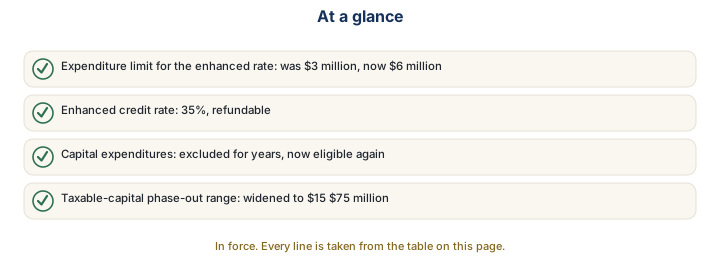
Quick answer: The expenditure limit for the enhanced 35% refundable SR&ED credit rose to $6 million, from $3 million under the previous rules. Capital expenditures are eligible again after years of exclusion.
How the SR&ED expenditure limit works
SR&ED — scientific research and experimental development — is Canada’s largest support programme for businesses that develop or improve products and processes. It gives a tax credit on qualifying work.
A Canadian-controlled private corporation can claim an enhanced credit at 35%, and that credit is refundable: it can produce a cash refund even when the company owes no tax. That is what makes it valuable to a company that is developing rather than profiting.
The enhanced rate applies only up to an expenditure limit. That limit rose to $6 million, from $3 million under the previous rules.
Capital expenditures are eligible again after years of exclusion, so equipment bought for the development work can count rather than being written off as outside the programme.
How it applies to you
CCPCs carrying out eligible development work — a far broader group than the word "research" suggests. Software development, process improvement and product development regularly qualify. Companies that assume the programme is for laboratories routinely leave the credit unclaimed.
The taxable-capital phase-out range widened to $15–$75 million, so larger companies retain more of the enhanced rate than before. Eligibility was also extended to certain Canadian public corporations.
Two groups should revisit their position: businesses that stopped claiming because they hit the old $3 million ceiling, and any that treated capital purchases as ineligible.
How to calculate it
What changed, at a glance:
| Step | Detail |
|---|---|
| Expenditure limit for the enhanced rate | was $3 million, now $6 million |
| Enhanced credit rate | 35%, refundable |
| Capital expenditures | excluded for years, now eligible again |
| Taxable-capital phase-out range | widened to $15–$75 million |
A figure of $4.5 million was announced in December 2024, then superseded by Budget 2025 at $6 million. So the move from the law as it previously stood is $3 million to $6 million — the $4.5 million figure never became the operative limit, and any planning done against it is out of date.
What changed
A $4.5 million limit was announced in December 2024; Budget 2025 superseded it with $6 million, so the effective move from the old law is $3 million to $6 million. The taxable-capital phase-out range also widened to $15–$75 million, and eligibility for the enhanced rate was extended to certain Canadian public corporations.
What to do
The practical hurdle is not the rate; it is documentation. A SR&ED claim is won or lost on records made at the time the work was done — what was attempted, what was uncertain, what was tried and what happened.
Records reconstructed afterwards are the single most common reason a claim fails on review. If you intend to claim, the time to set up the record-keeping is before the work, not at year-end.
If you stopped claiming because of the old ceiling, the limit has doubled. That is worth re-examining rather than assuming the position is unchanged.
The practical point. Businesses that stopped claiming because they hit the old ceiling should revisit, and so should any that wrote off capital purchases as ineligible. Contemporaneous documentation remains the practical hurdle: the claim is won or lost on records made at the time, not reconstructed afterwards.
The terms used on this page
- SR&ED
- Scientific research and experimental development — the federal tax credit programme for development work.
- CCPC
- Canadian-controlled private corporation. The enhanced 35% refundable rate is available to these.
- Refundable credit
- A credit that can be paid out in cash even where no tax is owing.
- Expenditure limit
- The ceiling on spending that attracts the enhanced rate. Now $6 million.
Common questions about SR&ED limit doubles to $6 million
What is the expenditure limit now?+
I read that the limit was $4.5 million. Which is right?+
I stopped claiming because I hit the old ceiling. Should I revisit?+
What is the hardest part of a claim in practice?+
Where this comes from
Every figure on this page is taken from the source below, not from interpretation:
General information, not tax advice. This page explains a change in general terms. It cannot account for your circumstances and does not create a professional relationship. Confirm anything that affects a decision — book a free consult.
Have a question about this?
A one-off Advice Call is a paid 45-minute session with a Chartered Professional Accountant — $200 plus GST, booked by email or phone with a secure payment link, credited against your first invoice if you become a client within 60 days. Looking for an accountant to take this on rather than an answer? The first consultation is free.
“Highly recommend working with Sunny. We switched to him last year for both our personal and small-business taxes — responsive, knowledgeable and quick.”