Lowest federal tax rate is now 14% — The lowest federal personal tax rate dropped from 15% to 14%
Quick answer: The bottom federal personal income tax bracket fell from 15% to 14.5% for the 2025 tax year, and to 14% for 2026 and later years.
How it works
Canada taxes personal income in brackets. Each bracket has a rate, and the rate applies only to the income inside that bracket — not to everything you earn. Someone in the second bracket still pays the first bracket's rate on the portion of their income that falls in the first bracket.
The lowest federal bracket's rate dropped from 15% to 14%. Because that bracket is the first one, every taxpayer with income in it benefits, regardless of how much they earn in total.
The change also affects non-refundable tax credits. Most are calculated by multiplying a credit amount by the lowest rate, so when the lowest rate falls, those credits are worth slightly less. The net effect for most people is still a reduction in tax.
It is worth being clear about what a marginal rate is, because the word causes more confusion than any other in personal tax. Your marginal rate is the rate on your next dollar of income, not on all of it. Someone described as "in the 29% bracket" does not pay 29% of their income in tax — they pay the lowest rate on the first slice, the next rate on the slice above that, and 29% only on the part that reaches that band.
That is why a cut to the lowest bracket reaches everyone. Income is taxed in layers, and every taxpayer has income in the bottom layer regardless of how high the top of their income goes.
How it applies to you
Every individual filing a Canadian return with income in the lowest bracket, which is nearly everyone who files.
The saving is capped by the size of the bracket, not by your income. A high earner does not save more than someone in the middle — both save the same amount on the same first slice of income.
Employers and payroll software apply this automatically through the withholding tables. If your software is current, your net pay already reflects it.
How to calculate it
To see the effect on your own tax:
| Step | Detail |
|---|---|
| Take the amount of your income that falls in the lowest bracket | |
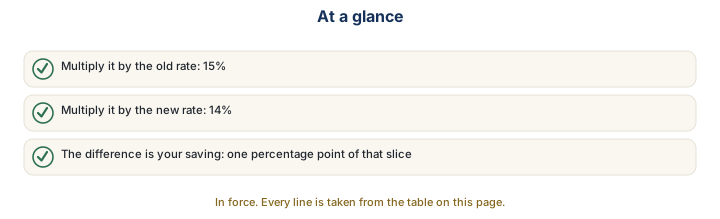
| Multiply it by the old rate | 15% |
| Multiply it by the new rate | 14% |
| The difference is your saving | one percentage point of that slice |
The rate applies to the first bracket only. Someone with $40,000 of income sees the reduction on the portion of that $40,000 falling in the lowest bracket; someone with $400,000 sees exactly the same reduction on exactly the same slice, because the rate above that slice has not changed.
What changed
The reduction took effect 1 July 2025. Because it applied for only half of that year, the CRA applies a blended rate of 14.5% to the 2025 return — 15% for January to June, 14% for July to December — and the full 14% from 2026.
What to do
A one-percentage-point cut to the lowest rate is a modest, universal reduction. It requires nothing from you.
If you calculate your own instalments or run payroll manually, use the current rate — a calculation carried over from last year overstates the tax due.
Because non-refundable credits are computed at the lowest rate, the headline saving overstates the benefit slightly for people claiming large credit amounts.
The practical point. Employers should confirm their payroll software is on the current tables. Owner-managers modelling salary versus dividends should rerun the comparison, because the personal side of that calculation moved.
The terms used on this page
- Marginal bracket
- A band of income taxed at a particular rate. The rate applies only to income inside that band.
- Non-refundable tax credit
- A credit that reduces tax owing but cannot create a refund on its own. Most are calculated at the lowest federal rate.
Common questions about lowest federal tax rate is now 14%
What rate applies to my 2025 return?+
Do I benefit if I am a high earner?+
Does this change how I should pay myself?+
Is there anything an employer needs to do?+
Where this comes from
Every figure on this page is taken from the source below, not from interpretation:
General information, not tax advice. This page explains a change in general terms. It cannot account for your circumstances and does not create a professional relationship. Confirm anything that affects a decision — book a free consult.
Have a question about this?
A one-off Advice Call is a paid 45-minute session with a Chartered Professional Accountant — $200 plus GST, booked by email or phone with a secure payment link, credited against your first invoice if you become a client within 60 days. Looking for an accountant to take this on rather than an answer? The first consultation is free.
“Personal. Professional. Responsive. Plus he saved me a bundle!”