Personal support worker tax credit — A refundable credit for personal support workers, up to $1,100 — but not in BC
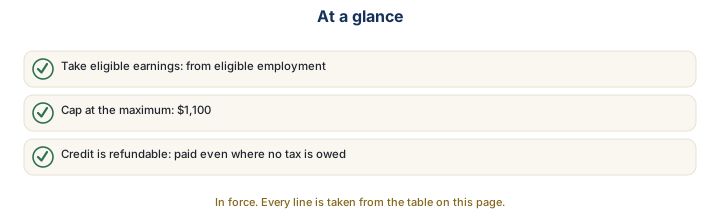
Quick answer: The temporary Personal Support Workers Tax Credit is worth 5% of eligible earnings, to a maximum of $1,100, for the 2026 to 2030 tax years. It does not apply in British Columbia — nor in Newfoundland and Labrador or the Northwest Territories — so for a BC worker there is nothing to claim.
How it works
The Personal Support Workers Tax Credit is a temporary refundable credit worth 5% of eligible earnings, to a maximum of $1,100, for the 2026 to 2030 tax years.
Refundable is the important word. A non-refundable credit can only reduce tax you owe to zero. A refundable one is paid to you even where no tax is owing — but only if a return is filed.
It does not apply in British Columbia, and it does not apply in Newfoundland and Labrador or the Northwest Territories.
Those three are excluded because each signed a bilateral agreement with the federal government under which it receives funding to raise personal support worker wages directly instead. The support arrives through pay rather than through the tax system.
The credit is temporary by design, running for the 2026 to 2030 tax years. It is not a permanent feature of the return, so a worker who becomes eligible partway through that window has a limited number of years in which to claim it.
Eligibility depends on both the worker and the workplace: the credit is for eligible personal support workers at eligible health care establishments. Doing similar work for an employer outside that definition does not qualify, which is why the employer certification matters rather than being a formality.
How it applies to you
Eligible personal support workers at eligible health care establishments — outside British Columbia, Newfoundland and Labrador, and the Northwest Territories.
For a worker based in BC, this credit is not available. That is worth stating plainly, because national coverage of the measure will not mention the exclusion and the disappointment usually arrives at filing time.
A BC worker is not worse off overall — the funding for their wages is meant to come through the provincial agreement instead — but there is nothing to claim on a return.
How to calculate it
How the credit is worked out where it applies:
| Step | Detail |
|---|---|
| Take eligible earnings | from eligible employment |
| Multiply by 5% | |
| Cap at the maximum | $1,100 |
| Credit is refundable | paid even where no tax is owed |
Roughly $22,000 of qualifying earnings produces the full $1,100, since 5% of $22,000 is $1,100. Earnings above that do not increase the credit. In British Columbia the calculation does not run at all.
What changed
Those three jurisdictions are excluded because each signed a bilateral agreement with the federal government under which it receives funding to raise personal support worker wages directly instead. Roughly $22,000 of qualifying earnings produces the full $1,100.
What to do
If you work in BC, there is nothing to claim here. That is the single most useful thing to know about this measure locally.
Outside those three jurisdictions, the claim depends on a certification of eligible remuneration from the employer, so it has to be requested rather than assumed.
Because the credit is refundable, a return must be filed to receive it — including by someone with income low enough that they might otherwise not file.
The practical point. The claim depends on a certification of eligible remuneration from the employer, so that has to be requested. The credit is refundable, meaning it is paid even where no tax is owed — but only if a return is filed.
The terms used on this page
- Refundable credit
- A credit paid to you even where no tax is owing, provided a return is filed.
- Non-refundable credit
- A credit that can reduce tax owing to zero but no further.
- Eligible remuneration
- The earnings the credit is calculated on, certified by the employer.
Common questions about personal support worker tax credit
Can I claim this in British Columbia?+
How much is the credit worth?+
What earnings produce the full amount?+
What do I need in order to claim it?+
Where this comes from
Every figure on this page is taken from the source below, not from interpretation:
General information, not tax advice. This page explains a change in general terms. It cannot account for your circumstances and does not create a professional relationship. Confirm anything that affects a decision — book a free consult.
Have a question about this?
A one-off Advice Call is a paid 45-minute session with a Chartered Professional Accountant — $200 plus GST, booked by email or phone with a secure payment link, credited against your first invoice if you become a client within 60 days. Looking for an accountant to take this on rather than an answer? The first consultation is free.
“I have worked with Sunny for the past 2 years. He is very knowledgeable and has saved me tons in taxes by restructuring my group of companies — the best accountant I've worked with in the last 10 years, after switching from three different firms.”