Bare trust reporting: 2025 and 2026 — Bare trusts: no T3 for 2025, but the rules return for 2026
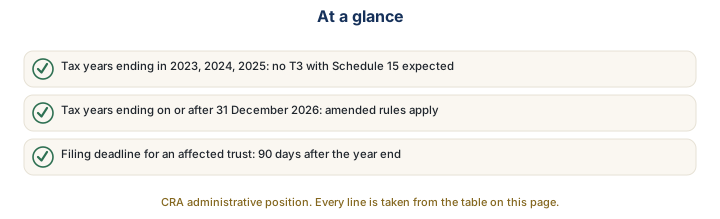
Quick answer: The CRA does not expect bare trusts to file a T3 return with Schedule 15 for tax years ending in 2023, 2024 or 2025. Amended legislated rules apply to tax years ending on or after 31 December 2026.
How it works
A bare trust is an arrangement where one person holds legal title to property while someone else is the real owner. The person on title has no discretion; they hold it in name only.
It is far more common than the word "trust" suggests. A parent added to a child’s mortgage to help them qualify, a nominee corporation holding real estate, a professional holding assets for a client — all can be bare trusts, and none involves a formal trust deed.
Trust reporting rules were extended to catch these arrangements, requiring a T3 return with Schedule 15. The requirement was then suspended administratively, year by year.
The CRA does not expect bare trusts to file for tax years ending in 2023, 2024 or 2025. Amended rules apply to tax years ending on or after 31 December 2026.
How it applies to you
Anyone holding property in name only for someone else, or having someone hold property for them. The arrangement is usually informal, which is exactly why it gets overlooked.
Bill C-15 amended the trust reporting rules, and from the 2026 return there are several exemptions — among them, where all beneficiaries are legal owners of the property and all legal owners are beneficiaries; where the legal owners are related individuals and the property could be designated a principal residence of one of them; and certain small holdings.
Whether a particular arrangement is caught turns on which exemption, if any, it fits. An arrangement is not exempt merely because it feels informal.
How to calculate it
The timeline, which is what matters most here:
| Step | Detail |
|---|---|
| Tax years ending in 2023, 2024, 2025 | no T3 with Schedule 15 expected |
| Tax years ending on or after 31 December 2026 | amended rules apply |
| Filing deadline for an affected trust | 90 days after the year end |
Ninety days is the part to plan around. For a 31 December 2026 year end that means filing by roughly the end of March 2027 — and finding every bare trust across a family or a corporate group reliably takes longer than three months, because nobody has a list of them.
What changed
The reporting requirement was introduced, then suspended administratively year by year. Bill C-15 amended the trust reporting rules, and from the 2026 return there are several exemptions — among them, where all beneficiaries are legal owners of the property and all legal owners are beneficiaries; where the legal owners are related individuals and the property could be designated a principal residence of one of them; and certain small holdings. Whether a particular arrangement is caught turns on which exemption, if any, it fits.
What to do
The relief for 2025 is administrative, not a repeal. The rules return, and treating the pause as the end of the matter is the mistake to avoid.
Identify the arrangements now rather than in early 2027. The work is not the filing; it is discovering which arrangements exist — whose name is on which title, and why.
Do not assume an arrangement is exempt without checking which exemption it relies on. The exemptions are specific, and "this is just my son’s house" is not one of them.
The practical point. The relief for 2025 is administrative, not a repeal. Identify the arrangements now rather than in early 2027 — the 2026 return falls due 90 days after the year end, and finding every bare trust in a family or corporate group reliably takes longer than that. Do not assume an arrangement is exempt without checking which exemption it relies on.
The terms used on this page
- Bare trust
- An arrangement where one person holds legal title while another is the real owner. The titleholder has no discretion.
- Legal title
- Whose name is on the ownership record — which can differ from who actually owns the property.
- Schedule 15
- The schedule to the T3 return reporting a trust’s beneficiaries and settlors.
- Administrative relief
- The CRA choosing not to enforce a requirement. It is not a change in the law, and it can end.
Common questions about bare trust reporting: 2025 and 2026
Do I need to file a T3 for a bare trust?+
Has the requirement been repealed?+
Am I exempt from the 2026 rules?+
Why start now rather than in 2027?+
Where this comes from
Every figure on this page is taken from the source below, not from interpretation:
General information, not tax advice. This page explains a change in general terms. It cannot account for your circumstances and does not create a professional relationship. Confirm anything that affects a decision — book a free consult.
Have a question about this?
A one-off Advice Call is a paid 45-minute session with a Chartered Professional Accountant — $200 plus GST, booked by email or phone with a secure payment link, credited against your first invoice if you become a client within 60 days. Looking for an accountant to take this on rather than an answer? The first consultation is free.
“Highly recommend working with Sunny. We switched to him last year for both our personal and small-business taxes — responsive, knowledgeable and quick.”