Employee ownership trust exemption — The $10 million employee ownership trust exemption is now permanent
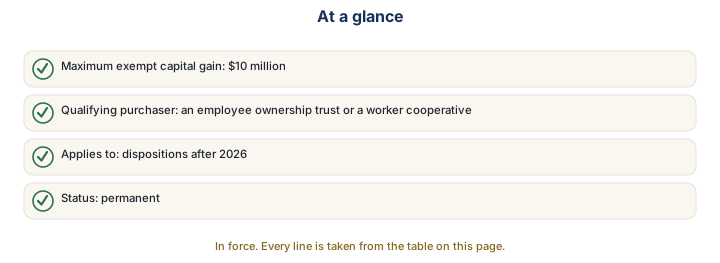
Quick answer: The exemption from tax on up to $10 million of capital gains on a qualifying sale of a business to an employee ownership trust or a worker cooperative has been made permanent, for dispositions after 2026.
How it works
Most business owners plan to sell one day. The usual routes are a third-party buyer or a family successor, and many owner-managed businesses have neither.
An employee ownership trust is a third route: the business is sold to a trust that holds it for the benefit of its employees. The owner is paid, and the people who already run the business come to own it.
To make that route viable, the tax system exempts up to $10 million of capital gains on a qualifying sale to an employee ownership trust or a worker cooperative.
That exemption was time-limited. It is now permanent, for dispositions after 2026.
The reason this route needs a tax measure at all is that employees rarely have capital. A third-party buyer arrives with financing; a workforce does not. The trust structure and the exemption together make it possible for a sale to be funded out of the business over time rather than paid up front.
It is worth being clear that this is a genuine sale rather than a giveaway. The owner is paid for the business. What differs is who the purchaser is, how the purchase is funded, and how the gain is taxed.
How it applies to you
Owners considering selling to their employees rather than to a third party. For an owner-managed business with no family successor and no obvious buyer, this is a realistic exit rather than a theoretical one.
Permanence is the substantive change. A time-limited exemption was very hard to plan around, because these transactions routinely take more than a year to arrange and a sale that slipped past the deadline lost the benefit entirely.
Removing that cliff means the structure can be built at the pace it actually needs rather than raced to a date.
How to calculate it
What the exemption covers:
| Step | Detail |
|---|---|
| Maximum exempt capital gain | $10 million |
| Qualifying purchaser | an employee ownership trust or a worker cooperative |
| Applies to | dispositions after 2026 |
| Status | permanent |
The $10 million is an exemption from capital gains on the sale, so it sits alongside the ordinary capital gains rules rather than replacing them. Gains beyond it are treated normally, with one-half included in income.
What changed
The exemption was time-limited, which made it very hard to plan around: a sale that slipped past the deadline lost the benefit entirely, and these transactions routinely take more than a year to arrange. Permanence removes that cliff.
What to do
If selling to your employees is a possibility, start the planning well before the intended sale year. This is a structural transaction, not a form to file.
Qualifying conditions attach to the trust, to the business and to the shares. Meeting them takes deliberate setup, and they are tested at the transaction rather than afterwards.
Permanence changes the calculation for owners who ruled this out because the deadline was unrealistic. That reason no longer applies.
The practical point. An employee ownership trust sale is a structural transaction with qualifying conditions attached to the trust, the business and the shares. It takes time to set up properly, so the planning starts well before the intended sale year.
The terms used on this page
- Employee ownership trust
- A trust that holds a business for the benefit of its employees.
- Worker cooperative
- A business owned and controlled by the people who work in it.
- Disposition
- The tax term for disposing of property — here, selling the business.
Common questions about employee ownership trust exemption
Is the $10 million exemption still time-limited?+
Why does permanence matter?+
How are gains above $10 million treated?+
When should planning start?+
Where this comes from
Every figure on this page is taken from the source below, not from interpretation:
General information, not tax advice. This page explains a change in general terms. It cannot account for your circumstances and does not create a professional relationship. Confirm anything that affects a decision — book a free consult.
Have a question about this?
Ask it free through the quick-question form and a CPA replies by email within one business day. For something that needs a proper look, a one-off Advice Call is a paid 45-minute session with a Chartered Professional Accountant — $200 plus GST, booked by email or phone with a secure payment link, credited against your first invoice if you become a client within 60 days. Looking for an accountant to take this on rather than an answer? The first consultation is free.
“I have worked with Sunny for the past 2 years. He is very knowledgeable and has saved me tons in taxes by restructuring my group of companies — the best accountant I've worked with in the last 10 years, after switching from three different firms.”