The 2026 automobile deduction limits — a $39,000 ceiling and a 73-cent allowance
Vehicle limits change what a company car is worth claiming, and the decision is easier before the purchase than after. The benefit calculator shows the taxable side of it.
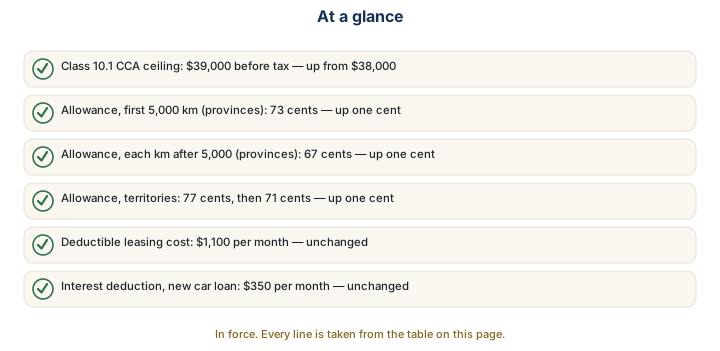
Quick answer: The capital cost allowance ceiling for a Class 10.1 passenger vehicle rose from $38,000 to $39,000 before tax for vehicles acquired on or after 1 January 2026, and the tax-exempt per-kilometre allowance rose one cent to 73 cents for the first 5,000 kilometres and 67 cents after that.
How it works
A business vehicle is not deducted the way an ordinary expense is. If the corporation owns it, the cost is written off gradually through capital cost allowance; if it leases, the monthly payment is deductible; if an employee uses their own car, the company can reimburse them by the kilometre. Each of those three routes has its own annual ceiling, and Finance Canada resets them every January.
A passenger vehicle costing more than the ceiling falls into Class 10.1. The ceiling matters because it caps the amount that may be depreciated regardless of what was actually paid. For vehicles acquired on or after 1 January 2026 that ceiling is $39,000 before tax, up from $38,000. Spend $70,000 and the corporation still depreciates $39,000.
The per-kilometre allowance is the other figure that moved. An employer may pay an employee a tax-exempt allowance for business use of their personal vehicle, and for 2026 the deductible limit is 73 cents for the first 5,000 kilometres in a year and 67 cents for each kilometre after that. Both rose by one cent. In the territories the rates are 77 cents and 71 cents.
Everything else held still. Deductible leasing costs remain $1,100 a month before tax on new leases, the interest deduction on a new car loan remains $350 a month, the Class 54 ceiling for zero-emission passenger vehicles remains $61,000, and the operating-cost benefit rate remains 34 cents a kilometre — 31 cents for people employed principally in selling or leasing automobiles.
How it applies to you
Any corporation that owns or leases a passenger vehicle, and any employer that reimburses employees by the kilometre.
For an incorporated owner-manager the Class 10.1 ceiling is usually the binding one. It is a cap, not a target: the write-off is limited to $39,000 of cost however much the vehicle cost.
For an employer paying mileage, the risk runs the other way. An allowance at or below the prescribed rate is tax-exempt to the employee and deductible to the company. Pay above it and the excess becomes a taxable benefit that has to go on the T4, which is why the rate is worth updating in payroll rather than leaving at last year’s figure.
How to calculate it
The 2026 figures, and which of them changed:
| Step | Detail |
|---|---|
| Class 10.1 CCA ceiling | $39,000 before tax — up from $38,000 |
| Allowance, first 5,000 km (provinces) | 73 cents — up one cent |
| Allowance, each km after 5,000 (provinces) | 67 cents — up one cent |
| Allowance, territories | 77 cents, then 71 cents — up one cent |
| Deductible leasing cost | $1,100 per month — unchanged |
| Interest deduction, new car loan | $350 per month — unchanged |
| Class 54 zero-emission ceiling | $61,000 — unchanged |
| Operating-cost benefit rate | 34 cents per km — unchanged |
An employee who drives 8,000 business kilometres in 2026 can be reimbursed 5,000 × 73 cents plus 3,000 × 67 cents, or $3,650 + $2,010 = $5,660, with none of it taxable to them and all of it deductible to the company. The rates apply to the calendar year, and the 5,000-kilometre count restarts each January.
What changed
Only two figures moved. The $1,100 monthly leasing deduction, the $350 monthly interest deduction, the $61,000 Class 54 zero-emission ceiling and the 34-cent operating-benefit rate are all unchanged for 2026. The territorial allowance rates also rose a cent, to 77 cents and 71 cents.
What to do
Change the mileage rate in payroll before the next run. It is a one-cent move, but paying above the prescribed rate creates a taxable benefit rather than a bigger deduction.
If the corporation is about to buy a passenger vehicle, the ceiling is the number that decides how much of the price is ever deductible. That belongs in the decision before the purchase, not at year-end.
The acquisition date governs, not the order date. The $39,000 ceiling applies to vehicles acquired on or after 1 January 2026.
The practical point. If you reimburse by the kilometre, update the rate in payroll before the next run — paying last year’s 72 cents is not wrong, but paying above 73 cents makes the excess a taxable benefit. If you are buying a vehicle in the corporation, the ceiling caps what can be depreciated no matter what you pay.
The terms used on this page
- Class 10.1
- The capital cost allowance class for a passenger vehicle costing more than the annual ceiling. Each vehicle sits in its own class, and no recapture or terminal loss arises on sale.
- Class 54
- The capital cost allowance class for zero-emission passenger vehicles, with its own separate ceiling.
- Capital cost allowance
- The tax deduction that writes off the cost of a capital asset over time rather than all at once.
- Tax-exempt allowance
- A per-kilometre payment for business use of a personal vehicle that is not taxable to the employee, provided it is reasonable and at or below the prescribed rate.
- Operating-cost benefit
- The taxable benefit on the personal share of vehicle running costs paid by an employer, calculated at a prescribed rate per personal kilometre.
Common questions about the 2026 automobile deduction limits
What is the mileage rate for 2026?+
How much of a company car can I actually write off?+
Did the leasing and interest limits change?+
What happens if I pay more than 73 cents a kilometre?+
Where this comes from
Every figure on this page is taken from the source below, not from interpretation:
General information, not tax advice. This page explains a change in general terms. It cannot account for your circumstances and does not create a professional relationship. Confirm anything that affects a decision — book a free consult.
Have a question about this?
Ask it free through the quick-question form and a CPA replies by email within one business day. For something that needs a proper look, a one-off Advice Call is a paid 45-minute session with a Chartered Professional Accountant: $200 plus GST, booked by email or phone with a secure payment link. It is credited against your first invoice if you become a client within 60 days. Looking for an accountant to take this on rather than an answer? The first consultation is free.
These ceilings bind when the vehicle is claimed, not when it is bought, so they belong in the corporate return the limits are applied on.
“I have worked with Sunny for the past 2 years. He is very knowledgeable and has saved me tons in taxes by restructuring my group of companies — the best accountant I've worked with in the last 10 years, after switching from three different firms.”