Tax brackets 2027 Canada: the federal and BC figures, and when they arrive
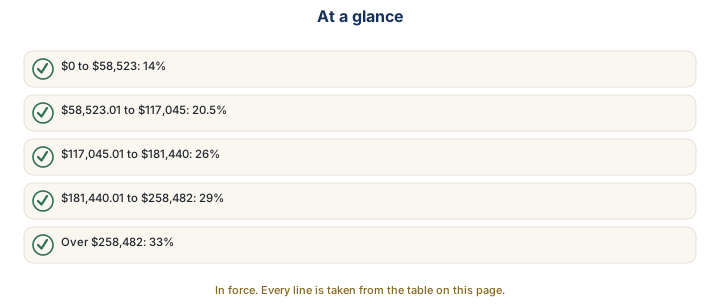
Quick answer: The 2027 tax brackets have not been published yet, federally or for BC. The CRA normally publishes the indexed thresholds and the indexing factor in November, and this page will show them once they are out. Until then, the latest published figures are the 2026 federal bands: 14% on the first $58,523, rising to 33% above $258,482.
On this page
- 2027 federal tax brackets: not yet published
- The 2026 federal brackets, for reference
- How indexation sets the 2027 brackets
- BC tax brackets 2027
- What is already known for 2027
- How it applies to you
- What to do before the figures arrive
- The terms used on this page
- Common questions about tax brackets 2027
- Where this comes from
2027 federal tax brackets: not yet published
As of 24 October 2026, the CRA has not published the 2027 federal tax brackets, the 2027 provincial brackets, or the indexing factor that produces them. Any table claiming to show the 2027 thresholds today is an estimate, not a published figure.
The pattern repeats each year. The CRA normally publishes the coming year’s indexed figures in November, and the January payroll tables carry them into withholding from the first pay run. We will add the 2027 federal and BC figures here once published, labelled with their source.
The 2026 federal brackets, for reference
| 2026 taxable income | 2026 rate | 2027 |
|---|---|---|
| $0 to $58,523 | 14% | Not yet published |
| $58,523.01 to $117,045 | 20.5% | Not yet published |
| $117,045.01 to $181,440 | 26% | Not yet published |
| $181,440.01 to $258,482 | 29% | Not yet published |
| Over $258,482 | 33% | Not yet published |
These are the 2026 federal bands, in force for the 2026 tax year. Each rate applies only to the portion of income inside its band. Earning a dollar over $58,523 does not tax the whole income at 20.5% — it taxes that dollar at 20.5%.
The full 2026 detail, including the mid-year BC change, is on the 2026 tax brackets page.
How indexation sets the 2027 brackets
Tax brackets and many credits are stated as dollar amounts. If those amounts never moved, inflation alone would push people into higher brackets and quietly erode the value of every credit — an effect called bracket creep.
Indexation prevents that. Thresholds and personal amounts move each year by an indexing factor, so the same real income faces roughly the same tax. The 2027 federal brackets will be the 2026 thresholds moved by the 2027 factor. Rates stay put; only dollar amounts move.
Federal and provincial factors are set separately and differ. For reference, the 2026 factors were:
| Jurisdiction | 2026 factor | 2027 factor |
|---|---|---|
| Federal | 2.0% | Not yet published |
| British Columbia | 2.2% | Not yet published |
| Ontario | 1.9% | Not yet published |
The 2026 factors are shown only to illustrate that the levels differ. They are not a guide to the 2027 factors, which have not been published. More on how the 2026 adjustment worked is on the 2026 indexation page.
Indexation is neither a tax cut nor a rise; it aims to leave you where you were. Federal and provincial factors differ, so for 2027 one combined assumption will drift.
BC tax brackets 2027
The 2027 BC tax brackets have not been published either. British Columbia indexes its own thresholds with its own factor, and the CRA carries the result into the BC payroll tables. Until the 2027 BC figures are out, these are the 2026 BC brackets:
| 2026 taxable income | 2026 BC rate |
|---|---|
| $0 to $50,363 | 5.6% |
| $50,363.01 to $100,728 | 7.7% |
| $100,728.01 to $115,648 | 10.5% |
| $115,648.01 to $140,430 | 12.29% |
| $140,430.01 to $190,405 | 14.7% |
| $190,405.01 to $265,545 | 16.8% |
| Over $265,545 | 20.5% |
Two 2026 details are worth carrying into the new year. First, the BC lowest rate rose from 5.06% to 5.6% on 17 February 2026, for 2026 and later years, and the BC basic reduction rose from $562 to $690. Second, the prorated 6.14% on the lowest band was a withholding device for the second half of 2026 only, to make up six months at the old rate. It is not the BC annual rate, which for 2026 is 5.6%.
Provincial tax is charged on its own brackets and added to the federal amount. A BC resident’s combined marginal rate for 2027 will therefore depend on two sets of figures, neither of which has been published yet.
What is already known for 2027
The brackets are not out, but two 2027 payroll changes are already confirmed and take effect on 1 January 2027:
| Figure | 2027 |
|---|---|
| Base CPP rate, employee and employer each | 4.75% (down from 4.95%) |
| Base CPP rate, self-employed (both halves) | 9.5% (down from 9.9%) |
| EI premium rate, employee | $1.64 per $100 of insurable earnings |
| EI maximum insurable earnings | $70,800 |
| EI maximum annual employee premium | $70,800 × 1.64% = $1,161.12 |
| Federal and provincial brackets | Not yet published |
The CPP figure is the base rate only and does not change the separate CPP2 contribution. The 2027 maximum pensionable earnings are also set in November. The detail is on the 2027 CPP rate page and the 2027 EI premium page.
How it applies to you
Everyone filing a Canadian return will be taxed on the 2027 brackets for income earned in 2027.
For an incorporated owner, the federal bands set the marginal cost of more salary, underpinning every 2027 salary-versus-dividend calculation. Plan now on the 2026 bands and recheck when 2027 figures land.
For an employer, the practical issue is making sure the payroll software loads the January 2027 tables, with the new brackets and the CPP and EI changes above, before the first pay run of the year.
What to do before the figures arrive
Do not plug an estimated 2027 threshold into a plan as though it were published. Use the 2026 figures, label them as 2026, and replace them in November.
If income sits close to a bracket boundary, or a bonus or dividend could fall either side of 31 December, note it now and rerun the numbers once the 2027 thresholds are out. That is where a small movement in a threshold changes the answer.
If you run payroll, plan for the January update: the new brackets, base CPP at 4.75% each for employee and employer, and EI at $1.64 per $100 up to $70,800 of insurable earnings.
The practical point. The 2027 brackets will be the 2026 thresholds indexed by a factor nobody has published yet. Plan on the 2026 figures, keep them labelled, and refresh them when the CRA publishes in November.
Brackets matter most when you can choose when income lands, as an owner-manager can; personal tax returns for owner-managers use them that way.
The terms used on this page
- Indexing factor
- The percentage by which bracket thresholds and personal amounts are adjusted each year for inflation.
- Marginal rate
- The rate applying to the next dollar earned, not to all income.
- Taxable income
- Income after deductions, which is what the brackets are applied to, not gross pay.
- Bracket creep
- The effect of inflation pushing income into higher bands, which indexing the brackets is designed to offset.
- Payroll deductions tables
- The CRA tables employers use to withhold tax, CPP and EI; the January edition carries the new year’s indexed figures.
Common questions about tax brackets 2027
What are the 2027 federal tax brackets?+
When will the 2027 tax brackets be released?+
What are the BC tax brackets for 2027?+
What is the 2027 indexing factor?+
Is anything confirmed for 2027 payroll?+
Will the tax rates change in 2027?+
Where this comes from
Every figure on this page is taken from the sources below, not from interpretation. The 2027 brackets will be added from the CRA once published:
- CRA — Current year tax rates and income brackets (2026)
- CRA — T4032BC payroll deductions tables, July 2026, general information
- CRA — income tax rates and income thresholds for payroll
- Spring Economic Update 2026 — Tax measures: supplementary information
- Canada Employment Insurance Commission — 2027 EI premium rate confirmed, 14 September 2026
General information, not tax advice. This page explains a change in general terms. It cannot account for your circumstances and does not create a professional relationship. Confirm anything that affects a decision — send an enquiry.
Have a question about this?
Ask free through the quick-question form; a CPA replies within one business day. Need more? A 45-minute Advice Call is $225 plus GST, credited to your first invoice if you become a client within 60 days. Want us to take it on? Send an enquiry.
Brackets decide the rate; what falls into each one is decided months earlier, and a personal return prepared against them is where that is worked out.
“…We switched to him last year for both our personal and small-business taxes — responsive, knowledgeable and quick.”