CPP rate 2027: the base rate falls to 9.5% — from 9.9% for the self-employed
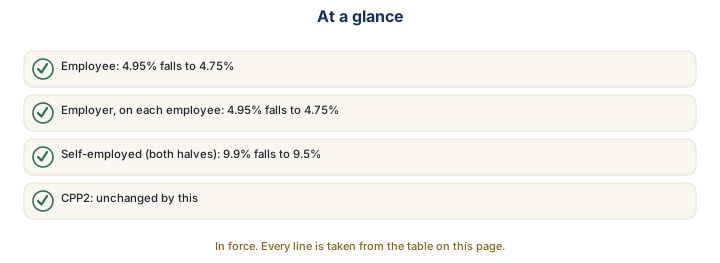
Quick answer: The base Canada Pension Plan contribution rate drops effective 1 January 2027. The employee and employer rates each fall from 4.95% to 4.75%, and the self-employed rate — which is both halves — falls from 9.9% to 9.5%.
How it works
Canada Pension Plan contributions are split between an employee and their employer. Each pays a rate on the employee’s pensionable earnings, and the two halves together are what funds the contribution.
A self-employed person has no employer, so they pay both halves themselves. That is why the self-employed rate is exactly double the employee rate, and why the two figures are so often confused in coverage of a change like this.
From 1 January 2027 the base rate falls. The employee rate goes from 4.95% to 4.75%, the employer rate falls by the same amount, and the self-employed rate — being both halves — goes from 9.9% to 9.5%.
This is the base CPP rate only. The separate CPP2 contribution on earnings above the year’s maximum pensionable earnings is not changed by this.
A rate cut to CPP is not the same as a tax cut, and it helps to understand why. CPP contributions buy pension entitlement — what you pay in determines what you eventually draw out. A lower rate means slightly less going in, so the change is a reduction in a mandatory saving as much as a reduction in a cost.
Whether any of this applies to you turns on your year-end, your structure and what else is in the picture — ask about your own situation and a CPA replies, usually the same business day. Free either way.
Contributions are also calculated on a band rather than on all earnings. Nothing is due on the first $3,500, and nothing is due above the annual ceiling. The rate applies only between those two lines, which is why the saving from a rate change is smaller than multiplying a salary by 0.2%.
How it applies to you
Every employer, every employee, and every self-employed individual.
The 9.9% figure quoted in most coverage is the self-employed rate. An employee reading that number and expecting their deductions to fall by 0.4 points will be disappointed — their own rate moves 0.2 points, from 4.95% to 4.75%.
For an incorporated owner-manager on salary the reduction lands twice, because the corporation pays the employer half. That is a genuine saving on both sides of the same decision.
How to calculate it
Which rate applies to you:
| Step | Detail |
|---|---|
| Employee | 4.95% falls to 4.75% |
| Employer, on each employee | 4.95% falls to 4.75% |
| Self-employed (both halves) | 9.9% falls to 9.5% |
| CPP2 | unchanged by this |
Nothing changes for 2026 payroll. The reduction starts with the first pay period of 2027, so a 2026 remittance calculated at the new rate would be wrong. Worth building into a 2027 budget, but not into this year’s.
What changed
The 9.9% figure quoted in most coverage is the self-employed rate. An employee sees 4.95% fall to 4.75%, and their employer sees the same reduction on its side. This is the base CPP rate and does not change the separate CPP2 contribution.
What to do
Confirm your payroll software has picked the change up before relying on the withholding in January 2027. Software does not always update on schedule, and CPP is one of the least forgiving remittances to get wrong.
If you are self-employed, the saving is the full 0.4 points because you pay both halves — the largest benefit of this change goes to the people who felt the cost most.
Do not restate 2026 figures. The rate for this year is unchanged.
The practical point. Nothing changes for 2026 payroll — the reduction starts with the first pay period of 2027. It is worth building into a 2027 budget, but confirm your payroll software has picked it up before relying on the withholding.
The terms used on this page
- Base CPP rate
- The main CPP contribution rate, applied to pensionable earnings up to the annual ceiling.
- Pensionable earnings
- The earnings CPP is calculated on, between the basic exemption and the annual ceiling.
- Self-employed rate
- Both halves combined, because a self-employed person is their own employer.
Common questions about CPP rate 2027: the base rate falls to 9.5%
Does my 2026 payroll change?+
Is my rate really falling from 9.9%?+
Does this change CPP2?+
What should I do now?+
Where this comes from
Every figure on this page is taken from the source below, not from interpretation:
General information, not tax advice. This page explains a change in general terms. It cannot account for your circumstances and does not create a professional relationship. Confirm anything that affects a decision — book a free consult.
Have a question about this?
A one-off Advice Call is a paid 45-minute session with a Chartered Professional Accountant — $200 plus GST, booked by email or phone with a secure payment link, credited against your first invoice if you become a client within 60 days. Looking for an accountant to take this on rather than an answer? The first consultation is free.
“Highly recommend working with Sunny. We switched to him last year for both our personal and small-business taxes — responsive, knowledgeable and quick.”