Payroll figures 2026: CPP and EI max $4,230.45 and $1,123.07
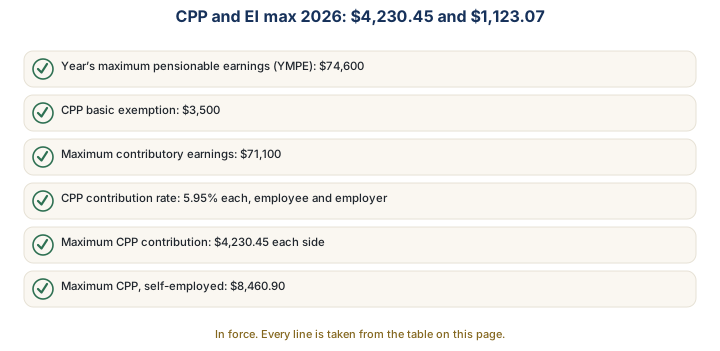
Quick answer: For 2026 the year’s maximum pensionable earnings is $74,600 and the CPP contribution rate is 5.95%, giving a maximum contribution of $4,230.45 each for employee and employer. Second CPP contributions apply between $74,600 and $85,000.
Every 2026 payroll figure, in one table
| Figure | 2026 |
|---|---|
| Year’s maximum pensionable earnings (YMPE) | $74,600 |
| CPP basic exemption | $3,500 |
| Maximum contributory earnings | $71,100 |
| CPP contribution rate | 5.95% each, employee and employer |
| Maximum CPP contribution | $4,230.45 each side |
| Maximum CPP, self-employed | $8,460.90 |
| Second ceiling for CPP2 (YAMPE) | $85,000 |
| CPP2 rate, on earnings from $74,600 to $85,000 | 4.0% each side |
| Maximum CPP2 contribution | $416.00 each side |
| Maximum insurable earnings for EI | $68,900 — up from $65,700 |
| EI premium rate, employee | $1.63 per $100 of insurable earnings |
| EI premium rate, employer | $2.28 per $100 — 1.4 times the employee rate |
| Maximum EI premium, employee | $1,123.07 |
| Maximum EI premium, employer | $1,572.30 per employee |
Add CPP and CPP2 together and an employee at or above the ceiling contributes $4,646.45 for the year, with the corporation matching it — close to $9,300 before a dollar of income tax. That combined figure is the one that belongs in the salary-versus-dividend decision, because dividends carry no CPP at all.
every remittance date for the year on one printable page. No email wall — it’s just useful.
Download the PDFTwo of the queries reaching this page name a province — “alberta cpp and ei max 2026”, “manitoba cpp and ei max 2026”. Every figure above is federal and identical in each province and territory except Quebec, which runs its own pension plan and its own parental insurance premium. An Alberta, Manitoba, Ontario or BC employer uses exactly these numbers.
How it works
If you have employees — including yourself, if your corporation pays you a salary — you must withhold amounts from each paycheque and send them to the CRA. Three of them matter here: Canada Pension Plan contributions, second CPP contributions, and Employment Insurance premiums.
CPP works between two lines. The first is the basic exemption of $3,500, below which no contributions are due. The second is the year's maximum pensionable earnings, or YMPE, which for 2026 is $74,600. You contribute 5.95% of earnings between those two figures, and your employer contributes the same amount again.
Above the YMPE a second tier begins, called CPP2. It applies to earnings between $74,600 and $85,000 for 2026. This is not a higher rate on all your income — it is a separate contribution on that band only.
Employment Insurance is simpler: a premium on insurable earnings up to a ceiling, which rose from $65,700 to $68,900 for 2026. The employer pays 1.4 times the employee's premium.
How it applies to you
Every employer withholds and remits these. So does every incorporated owner-manager who pays themselves a salary — your corporation is your employer, and it owes the employer half.
That employer half is the part owner-managers routinely overlook. On a salary at or above the ceiling, the maximum CPP contribution for 2026 is $4,230.45 from the employee. Adding CPP2, the employee's total CPP for the year is $4,646.45 — and the corporation matches it. The combined cost is close to $9,300 before any income tax.
Running payroll through your own corporation puts you on the other side of these rules rather than reading about them — if you want the version that applies to your company rather than the general case, send the question and a CPA answers it, usually the same business day.
That figure is why CPP belongs in the salary-versus-dividend decision rather than being filed away as a payroll detail. Dividends carry no CPP. Salary does, on both sides.
How to calculate it
To work out an employee's CPP for the year, take it in these steps:
| Step | Detail |
|---|---|
| Take pensionable earnings for the year | usually gross salary |
| Subtract the basic exemption | $3,500 |
| Cap the result at the YMPE less the exemption | $74,600 − $3,500 = $71,100 |
| Multiply by the CPP rate | 5.95% |
| That is the employee’s base CPP | maximum $4,230.45 for 2026 |
| If earnings exceed the YMPE, add CPP2 on the band above it | between $74,600 and $85,000 |
Worked through at the ceiling: $74,600 − $3,500 = $71,100 of contributory earnings. $71,100 × 5.95% = $4,230.45. That is the employee's base CPP maximum for 2026, and the employer pays $4,230.45 as well. With CPP2 the employee's total reaches $4,646.45, matched again by the employer. Someone earning less than the ceiling contributes 5.95% of their earnings above $3,500, not the maximum.
What changed
Both the CPP and EI ceilings rose. EI maximum insurable earnings increased from $65,700 to $68,900. Adding CPP2, an employee at or above the ceiling contributes $4,646.45 in total CPP for 2026, and the employer matches it.
What to do
If you pay yourself a salary from your own corporation, treat CPP as a cost with two halves, because that is what it is. The employee half comes off your paycheque and the employer half comes out of the company — and both are real money leaving the same group of accounts you own.
CPP is not purely a cost. It buys future pension entitlement, and for many owner-managers that is worth having. The point is to make the decision knowingly rather than discovering the employer half at year-end.
The rates and ceilings change every January. Anything you calculated using last year's figures will be wrong for this year, and payroll software does not always update on schedule.
The practical point. For an owner-manager, CPP and CPP2 are a real cost on both sides of the salary decision, since the corporation pays the employer half. They belong in the salary-versus-dividend calculation rather than being treated as a payroll detail.
The terms used on this page
- YMPE
- The year's maximum pensionable earnings — the ceiling for base CPP contributions. $74,600 for 2026.
- Basic exemption
- The first $3,500 of earnings, on which no CPP is due.
- CPP2
- A second contribution on earnings between the YMPE and a higher ceiling — $74,600 to $85,000 for 2026.
- Insurable earnings
- The earnings EI premiums are charged on, up to $68,900 for 2026.
Common questions about CPP and EI max 2026: $4,230.45 and $1,123.07
What does an employee at the ceiling contribute in 2026?+
How is the base CPP maximum worked out?+
What if I earn less than the ceiling?+
Does this change the salary-versus-dividend decision?+
Where this comes from
Every figure on this page is taken from the source below, not from interpretation:
- CRA — CPP contribution rates, maximums and exemptions
- ESDC — 2026 Employment Insurance premium rate
- CRA — Second additional CPP (CPP2) contribution rates and maximums
General information, not tax advice. This page explains a change in general terms. It cannot account for your circumstances and does not create a professional relationship. Confirm anything that affects a decision — book a free consult.
Have a question about this?
A one-off Advice Call is a paid 45-minute session with a Chartered Professional Accountant — $200 plus GST, booked by email or phone with a secure payment link, credited against your first invoice if you become a client within 60 days. Looking for an accountant to take this on rather than an answer? The first consultation is free.
“Sunny and his team have been completing my bookkeeping, taxes and financials for the last 2 years and they have been amazing. Thank you!”