Capital gains inclusion rate: still one-half — the proposed increase was cancelled and never took effect
Quick answer: The proposed increase in the capital gains inclusion rate from one-half to two-thirds was deferred and then cancelled. It never took effect. Capital gains continue to be included in income at one-half.
How it works
When you sell something for more than you paid, the profit is a capital gain. Tax is not charged on the whole gain — only on a fraction of it, called the inclusion rate. That fraction is included in your income and taxed at your ordinary rate.
The inclusion rate is one-half. On a $100,000 gain, $50,000 is added to your income and taxed; the other $50,000 is not taxed at all.
In the 2024 federal budget the government proposed raising the rate to two-thirds. That proposal was deferred in January 2025 and then cancelled outright in March 2025. It never took effect, and the one-half rate applied throughout.
How it applies to you
This affects anyone who sells an asset at a profit outside a registered account: shares, a rental property, a cottage, a business, or equipment held by a corporation.
It does not affect your principal residence if it qualifies for the principal residence exemption, and it does not affect gains inside a TFSA or RRSP, which have their own treatment.
The practical consequence of the cancellation is that planning done in 2024 in anticipation of a higher rate — accelerating a sale, triggering a gain early — was based on a rule that never arrived. If you acted on it, the transaction still stands and its tax consequences are real.
How to calculate it
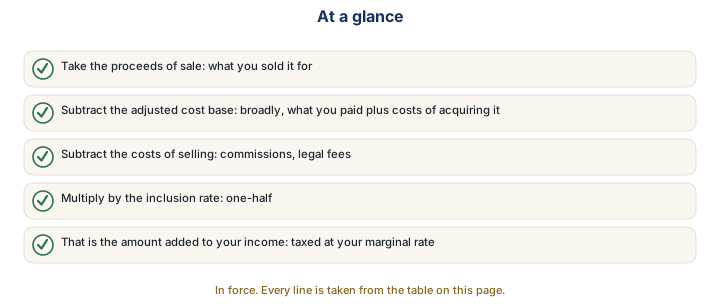
To find the taxable portion of a capital gain:
| Step | Detail |
|---|---|
| Take the proceeds of sale | what you sold it for |
| Subtract the adjusted cost base | broadly, what you paid plus costs of acquiring it |
| Subtract the costs of selling | commissions, legal fees |
| The result is your capital gain | |
| Multiply by the inclusion rate | one-half |
| That is the amount added to your income | taxed at your marginal rate |
Worked through: sell shares for $250,000 that you bought for $100,000, with $5,000 of selling costs. The gain is $250,000 − $100,000 − $5,000 = $145,000. At the one-half inclusion rate, $72,500 is added to your income for the year. The remaining $72,500 is not taxed.
What changed
The increase was announced in the 2024 federal budget, deferred on 31 January 2025 to 1 January 2026, and then cancelled on 21 March 2025. No version of it ever came into force.
What to do
The one-half inclusion rate is the rule. The increase was announced, deferred and cancelled, and no version of it ever applied.
One part of the same package was kept: the lifetime capital gains exemption increase to $1.25 million. Two measures announced together met different fates, which is exactly why "announced" and "in force" are worth distinguishing.
Before triggering a large gain deliberately, the timing matters more than the rate — spreading a sale across two tax years can keep more of it in lower brackets.
The practical point. If a 2024 or 2025 transaction was planned, reported or accrued on the assumption of a two-thirds inclusion rate, it should be revisited. Some returns were filed during the period when the increase was still expected.
The terms used on this page
- Capital gain
- The profit when you sell an asset for more than its adjusted cost base.
- Inclusion rate
- The fraction of a capital gain that is included in taxable income. One-half.
- Adjusted cost base
- Broadly what you paid for an asset, plus the costs of acquiring it and certain later adjustments.
- Marginal rate
- The rate of tax on your next dollar of income, which is what a capital gain is taxed at once included.
Common questions about capital gains inclusion rate: still one-half
Do I still pay tax on half my capital gain?+
I filed a return assuming the higher rate. What now?+
How much of a $145,000 gain is taxed?+
Does this affect the lifetime capital gains exemption?+
Where this comes from
Every figure on this page is taken from the source below, not from interpretation:
- Prime Minister of Canada — cancellation announcement, 21 March 2025
- Department of Finance — deferral announcement, 31 January 2025
General information, not tax advice. This page explains a change in general terms. It cannot account for your circumstances and does not create a professional relationship. Confirm anything that affects a decision — book a free consult.
Have a question about this?
A one-off Advice Call is a paid 45-minute session with a Chartered Professional Accountant — $200 plus GST, booked by email or phone with a secure payment link, credited against your first invoice if you become a client within 60 days. Looking for an accountant to take this on rather than an answer? The first consultation is free.
“Highly recommend working with Sunny. We switched to him last year for both our personal and small-business taxes — responsive, knowledgeable and quick.”